



Masuk
Masuk


0

3 bulan lalu
1 Jam, 14 Menit
How PMs Ship 100K Lines of Code at OpenAI with Ryan Lopopolo, Member of Technical Staff
25 Mei 2026
Today’s episode
Most companies are still debating whether PMs should ship code.
OpenAI is already debating the best ways for PMs to ship code.
They’re living in the future.
The builder behind a lot of that harness engineering is Ryan Lopopolo. He wrote the OpenAI post on harness engineering and runs a frontier team where PMs, designers, and engineers all ship using the same system.
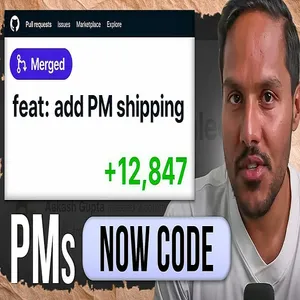
The wild part for me? His PMs shipped around 100K lines of production code.
Did they open the IDE? Hell no! Their coding happened through PRDs, tests, docs, and harness rules. The model did the typing.
As someone who spent a decade in PM growth roles, I’ve seen how long it takes to move a feature from PRD in a doc to code in prod. For most companies, that latency is weeks.
In Ryan’s world, it can be days, and the PM is inside the loop instead of watching from Jira. So I wanted to get to the bottom of this:
* What does the harness look like when PMs can ship like that?
* How do engineering teams set PMs up so they don’t ship slop?
* What changes in the EPD trio when code is cheap, and validation is the bottleneck?
That’s today’s episode, and I come with receipts as Ryan goes deep.
----
Check out the conversation on Apple, Spotify, and YouTube.
Brought to you by:
* Product Faculty - Get $550 off their #1 AI PM Certification with code AAKASH550C7
* Bolt - Ship AI-powered products 10x faster
* Customer.io - Send smarter messages using your product data
* Ariso - Ship AI agents and features faster, with fewer regressions
* Pendo - The #1 software experience management platform
----
* If you want access to my AI tool stack - Dovetail, Arize, Linear, Descript, Reforge Build, Relay.app, Magic Patterns, Speechify, Bolt.new and Mobbin - become an annual subscriber ($150), and grab Aakash’s bundle.
* If you want access to my AI PM customizations - PM OS, Job Search OS, and Prompt Library - become a founding subscriber ($250).
----
Key Takeaways:1. Code is a liability, not an asset - Every engineering org was built around the assumption that code is expensive to produce, validate, and deploy. Codex inverts this. Code is now the cheapest part of the stack and the constraint moves to how clearly you describe the problem.2. The new constraint is product decisions per week - With code generation effectively free and parallel, the bottleneck is no longer keystrokes. It is the quality of the brief, the clarity of the architectural boundaries, and the speed of verification.3. A billion tokens a day is the new floor - Ryan's claim is that if you are not running this volume you are negligent. The math comes out to roughly $2K to $3K per engineer per month, which is trivial against the headcount cost of human-only execution.4. A single PR can burn 350 million tokens - One refactor that would have taken Ryan three weeks ran on Codex for 60 hours straight across three days. He gave it two prompts total after the initial spec. The output matched what he would have produced himself.5. The harness is the actual product - Codex CLI is the surface. The harness is everything that gets the agent the right context at the right phase. Pre-work, messy middle, and close. Each phase needs different context, different tools, and different verification.6. agents.md is forcibly injected context - This file lives in the repository root and is always loaded into the agent's context. Use it for the operating model and the non-negotiable rules. Everything else gets pulled in dynamically because context is a hard, scarce resource.7. The painted-door technique works inside the codebase - Ryan's team enforces package boundaries so a designer can paint a fake UI on top of stubbed APIs. Real usage signal, no backend cost. This only works because the architecture refuses to permit a ball of mud.8. The PM's PRD can become a shipped PR in one week - In Ryan's setup, the PM wrote a markdown PRD, the team reviewed it in a Monday meeting, and a working feature shipped to customers by the following week with zero PM-to-engineer back-and-forth.9. The Monday morning roadmap starts with legibility - The first move is making the repository legible to the agent. Write the implicit team decisions down in a documentation tree. Use @-mention Codex to keep that tree updated whenever a Slack thread surfaces a new guardrail.10. One agent beats multi-agent handoffs - The lossy friction of agent-to-agent handoffs costs more than it saves. The right answer is one agent with full addressability over design, backend, and frontend, powered by a model good enough to hold the whole task in context.
----
Where to find Ryan Lapopolo
* X
* LinkedIn
* OpenAI
Related content
Podcasts:
* How to Run Evals in Claude Code with Aparna Dhinakaran
* How to Build a Full AI Dev Team in Claude Code with Gabor Mayer
* This CPO Uses Claude Code to Run His Entire Work Life with Dave Killeen
Newsletters:
* PM’s Guide to Claude with Pawel Huryn
* How to Become a Builder PM with Mahesh Yadav
* How to Build a Team OS in Claude Code with Hannah Stulberg
----
PS. Please subscribe on YouTube and follow on Apple & Spotify. It helps!
If you want to advertise, email productgrowthppp at gmail.
This is a public episode. If you'd like to discuss this with other subscribers or get access to bonus episodes, visit www.news.aakashg.com/subscribe
rss
The Growth Podcast
Komentar


Lihat episode lain